Volkswagen
Note: This is a daily stock update and the information stands true as of 25/03/26, 09:00 CET.
Company Update:
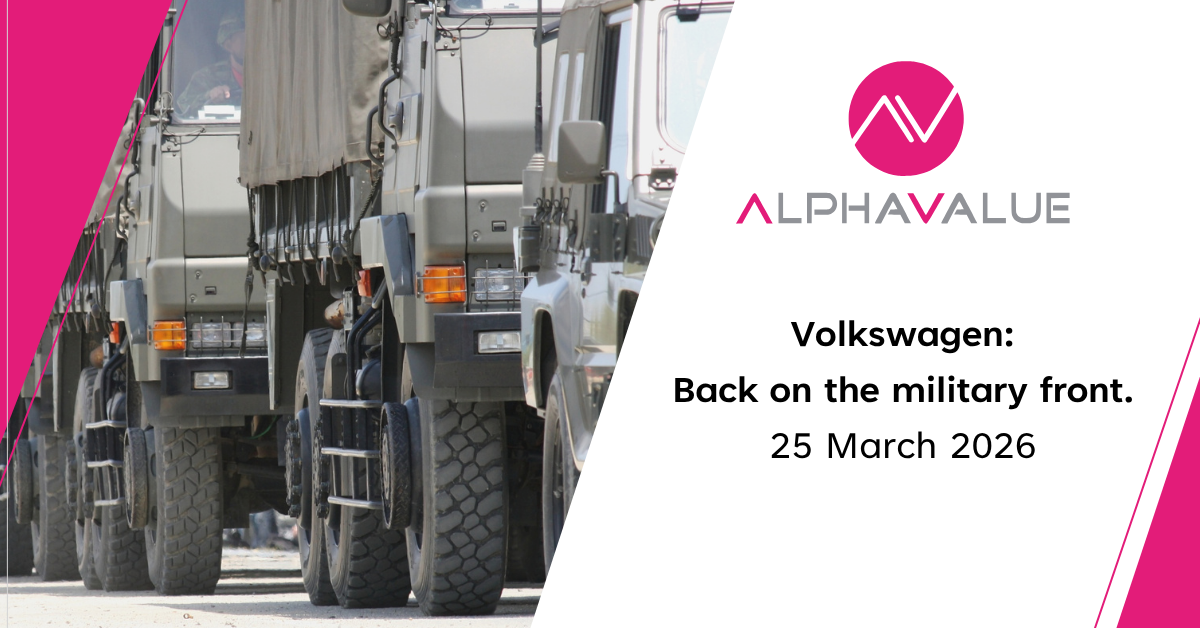
According to the FT, Volkswagen is in talks with Israel’s state-owned Rafael Advanced Defense Systems to switch production at the group’s Osnabrück factory from cars to military equipment, with the objective of supplying missile-related systems to governments that are reportedly supportive of the proposal. The plant would not manufacture missiles, but rather heavy-duty trucks, launchers, and electricity generators.
The Osnabrück plant, which employs around 2,300 people and is focused on convertibles, roadsters, and low-volume vehicles, was acquired by Volkswagen from Wilhelm Karmann GmbH after it went bankrupt in 2009.
With Porsche 718 Cayman and Porsche 718 Boxster production set to end in 2026 and the Volkswagen T-Roc Cabriolet in 2027, the plant illustrates Volkswagen’s structural overcapacity in Europe. The site was not specifically included in the group’s 2024 restructuring plan, but the absence of an electric platform allocation suggests the plant has limited long-term prospects within Volkswagen’s core automotive manufacturing footprint.
Our takeaways:
Overall, the project confirms that the Osnabrück plant is not part of Volkswagen’s long-term EV manufacturing strategy and highlights both the group’s European overcapacity and the political constraints around plant closures, making repurposing existing industrial capacity a likely restructuring path going forward.
Expert Opinion:
The key takeaway is that the group simply cannot cut jobs in Germany and that it is oversized in light of the weak demand for its products. Despite the low valuation, we still see no reason to be long the sector at this stage. Competition from China and adverse European regulation will make life extremely tough going forward for European car manufacturers
For daily updates, subscribe to our newsletter and for detailed information, reach out to us at sales@alphavalue.eu
The Osnabrück plant, which employs around 2,300 people and is focused on convertibles, roadsters, and low-volume vehicles, was acquired by Volkswagen from Wilhelm Karmann GmbH after it went bankrupt in 2009.
With Porsche 718 Cayman and Porsche 718 Boxster production set to end in 2026 and the Volkswagen T-Roc Cabriolet in 2027, the plant illustrates Volkswagen’s structural overcapacity in Europe. The site was not specifically included in the group’s 2024 restructuring plan, but the absence of an electric platform allocation suggests the plant has limited long-term prospects within Volkswagen’s core automotive manufacturing footprint.
Our takeaways:
- Volkswagen already manufactures military trucks through a joint venture with Rheinmetall, but this partnership would represent a more significant step into defense-related industrial production. The project highlights increasing links between the automotive and defense industries in Europe as defense spending rises, and the conversion of automotive plants to defense production could become a broader trend across the region, including BMW and Mercedes.
- Government involvement also suggests political pressure to preserve industrial jobs rather than allow plant closures, reinforcing the view that it remains difficult for Volkswagen to close plants in Germany and that capacity repurposing, rather than closures, will likely be a key tool to address overcapacity.
- From an industrial perspective, defense-related production could provide more stable and potentially higher-margin revenues than niche automotive production while requiring limited incremental investment compared with retooling the plant for electric vehicle production. This solution also appears preferable to selling the plant to a Chinese competitor.
- From an ESG perspective, however, the move creates a mixed signal, as increased exposure to defense-related activities could deter certain ESG-focused investors.
Overall, the project confirms that the Osnabrück plant is not part of Volkswagen’s long-term EV manufacturing strategy and highlights both the group’s European overcapacity and the political constraints around plant closures, making repurposing existing industrial capacity a likely restructuring path going forward.
Expert Opinion:
The key takeaway is that the group simply cannot cut jobs in Germany and that it is oversized in light of the weak demand for its products. Despite the low valuation, we still see no reason to be long the sector at this stage. Competition from China and adverse European regulation will make life extremely tough going forward for European car manufacturers
For daily updates, subscribe to our newsletter and for detailed information, reach out to us at sales@alphavalue.eu
Subscribe to our blog


Alphavalue Morning Market Tip
IRIS² Program will provide visibility beyond 2030 - Attractive risk reward profile.