Lower Flying Aerospace
AlphaValue’s Aerospace & Defence coverage lost appreciable altitude (-13%) over the last month since the start of the Hormuz war. This move is counterintuitive. Historically, geopolitical tensions act as a tailwind for defence equities.
A war that makes defence slip (performance to 31-03 close)
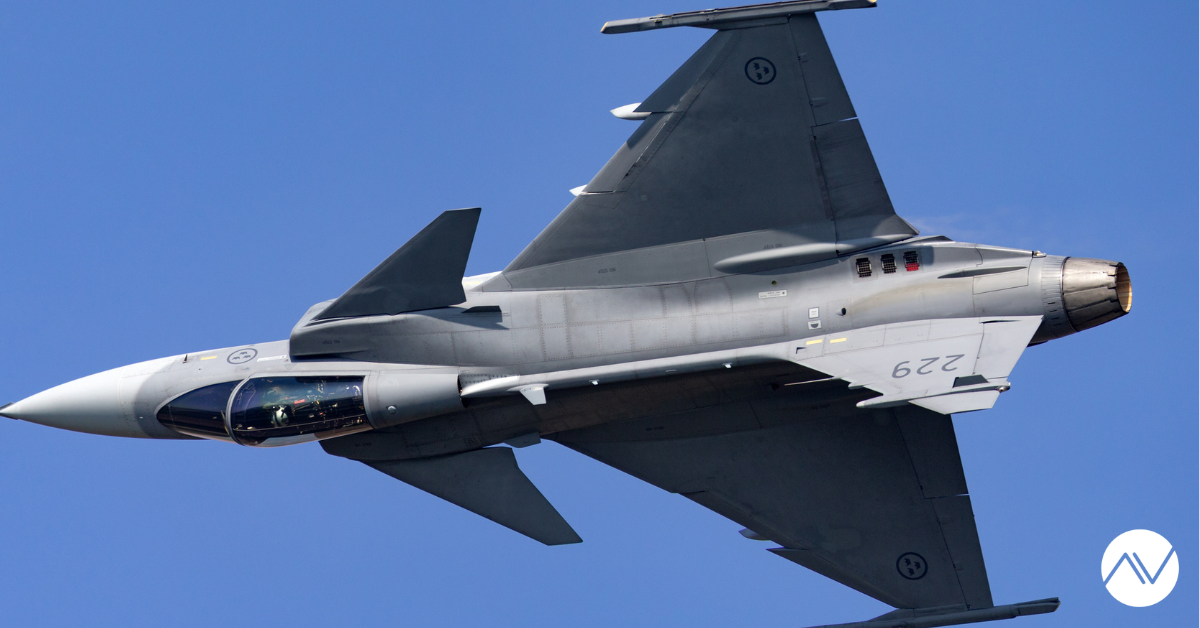
Saab (not covered) fell too. So did most Defence stocks, including US and Chinese ones. One of the few begging to differ is Norwegian Kongsberg, as it piles up ever bigger naval orders.
It is easy to see the negatives of the Hormuz mess for aero engine manufacturers: lesser flying by airlines kills the maintenance revenues (an aircraft tends to fly about 12h a day). Furthermore, avoiding Middle Eastern or Russian airspace forces airlines to take detours that extend flight times by 15% to 20%. This burns more fuel and accelerates engine wear at a time when the global supply chain is severely bottlenecked on crucial spare parts like titanium.
On the defence front, the rationale for investors to walk away is rather less obvious. Of course, Iran/Hormuz is a US military effort, so that the benefits of restocking military kit will accrue to US players. This has not prevented their share prices from tanking. Conversely, the UK and French efforts to back up GCC countries’ defence, open modest attrition related business for equipment providers (BAE, Dassault Aviation, RR, Safran, MTU), and possibly plain re-ordering of extra kit as a lesson is being learnt about the shape of the war. Trump’s cannot-care-less attitude vis a vis the wider region may also leave opportunities for non-US defence systems providers to step in.
Ramping up at a cost?
The AlphaValue analyst points out as well that the easy bit, collecting mega orders to re-arm Europe notably, is the easy bit. Ramping up production is more complex. Europe's industrial fragmentation, producing 17 different models of main battle tanks compared to the US's single Abrams, creates massive production inefficiencies. This has always been the case but the fact that a VW or a Renault are called upon to the rescue for volume based equipment does show that some value has gone to third parties. This may be a structural shift if tomorrow’s wars are about launching swarms of cheap drones across the air or the seas. We are shifting to an era of ruthless asymmetric economics, where firing a $4 million Patriot missile to down a $20,000 Iranian-designed Shahed drone is a fast track to bankrupting Western defense budgets. Metal bashing in volume of light kit combining with layers upon layers of AI is not the incumbents’ business model.
Competition
In addition to a VW eventually turning itself into a full fledged defence manufacturer, the astounding learning curve of Ukrainian drone manufacturers turns them into de facto global players. This adds to the competition coming from the likes of Korean Hanwa supplying full armored wheels or just chassis. Hanwha is aggressively eating Europe's lunch by promising deliveries in months, not half-decades, turning speed into the ultimate competitive moat. European players are pushed willingly or not into the field of systems, notably air defence. In short the business model is changing, fast, and when it comes to systems, US big data players (Anthropic down to Palantir) will have much sway, treating legacy defense companies as mere hardware providers while capturing the high-margin "brain" of the weapons via software and AI.
The above highlights a worry. A clear possibility is that current extra-large orderbooks hide a shift in business models where defence electronics of yore give way to innovative new entrants if they can manufacture in volume.
Such comments do not come close to explaining why the sector tanked of late. However, it is worth keeping in mind. For now, a simple strategy is to buy Airbus again with a 26% upside potential. AlphaValue made a clear investment case recently: Airbus Group | AIR FP | Aerosp. & Defence Equipt. | Netherlands | Updates | AlphaValue - Equity Research.
Subscribe to our blog



Apollo's 715p offer for easyJet looks generous at first glance, but the small print tells a different...